www.ibikeoulu.com: ”Winter Cycling Congress in Oulu 13.-14.2.2013 – Call for papers”

1. ALUEKEHITYS, 2. TULEVAISUUDEN ENNAKOINTI, 3. STRATEGIAPROSESSIT, 4. Osaamis- ja koulutustarpeiden ennakointi, 6. Kaivostoiminta, 7. Logistiikka ja yhteydet, 8. Energia ja ympäristö, 9.1 Matkailu, 9.2 Kauppa, rakentaminen, ICT, hyvinvointi, palvelut, IN ENGLISH, O. YHDYSKUNTASUUNNITTELU JA MAANKÄYTTÖ

www.ibikeoulu.com :

”WHY ATTEND?

Winter cycling congress is the only international cycling conference concentrating on winter cycling. The two day event offers delegates from around the world a chance to share best practices for creating and sustaining cycling-friendly cities though out the year, even in challenging winter conditions…

WHEN AND WHERE?

The winter cycling congress takes place 13th and 14th of February 2013 in Oulu, Finland. The conference is held in the Holiday Inn hotel, right in the middle of the city and next to the market square.

CALL FOR PAPERS

The winter cycling congress is now open for presentation proposals. The conference consists of oral presentation 20 minutes each. The Call For Papers is open until 12th of November 2012. Winter cycling is not very widely studied field of expertise. Therefore it’s even more important to share the visions, strategies, experiences, and results.”


Wild Card “Gas from Trash”

1. ALUEKEHITYS, 2. TULEVAISUUDEN ENNAKOINTI, 3. STRATEGIAPROSESSIT, 4. Osaamis- ja koulutustarpeiden ennakointi, 8. Energia ja ympäristö, IN ENGLISH, METODI, O. YHDYSKUNTASUUNNITTELU JA MAANKÄYTTÖ

Myllylä, Yrjö & Maurizio Sajeva & Jari Kaivo-oja & Samuli Aho (2011). iKnow Delphi 2.0  Country Report Finland. 104 p. October 2011. iKnow Project, Finland Futures Research Centre FFRC. < www.iknowfutures.eu>  < http://www.utuonline.fi/sisalto/ajankohtaista/jatteista-tuotettavasta-kaasusta-tarkea-energialahde.html> <http://ffrc.utu.fi/ajankohtaista/iknow.html>

Pages 67-72:

4.3.6   Wild Card “Gas from Trash”

  • The wild card “Gas from Trash” is “slightly original”, its level of importance for the STI policy at country level Finland  is “moderate”, while at EU-level it is “high”
  • The likelihood of the wild card “Gas from Trash” occuring in the short term is “moderate”, while occurring at longer-term is “high”
  • The wild card’s potential impact at country level for Finland and at EU-level is greatest for “Environment & ecosystems, Economy, and Science, technology&innovation(STI)systems”
  • The most relevant RTD strategy for this wild card is “Developing cross-national research programmes and priorities”
  • The level of preparedness of decision makers to deal with this wild card is “low” at country level for Finland and at EU-level.
  • According to respondents’ comments, many existing signals, like “High oil price” indicate that such wild card could happen
  • To sum up/The conclusions: The production of this wild card “Gas from Trush” is very ‘possible’, and more attention should be paid to it. The preparedness of decision-makers is low. The likelihood of its occurrence is high in the long term. Cross-national research programmes and priorities should be developed by strengthening research institutions’s knowledge production, developing world-class research infrastructures and promoting international cooperation in STI. In Finland a context in which natural gas and gas from trash are combined and distributed in some pipelines already exist in the region of Kouvola. It indicates that in Finland natural gas and gas from Trash (and other biomaterial, like from forest) should be analysed at the same time.

Gas from Trash Wild Card description: “The future of factories, which make gasoline, diesel and jet fuel, can be different. In the future they may be microscopic, and they might run on the garbage hydrocarbons that are all around us.” (www.iknowfutures.eu).

First reaction, importance and occuring in the timeframes

Wild card “Gas from Trash” is “slightly original”. Its level of importance for STI policy in country level Finland  is “moderate”, at EU-level “high” (Table 32).

Table 32.              Importance of Wild Card “Gas from Trash”.
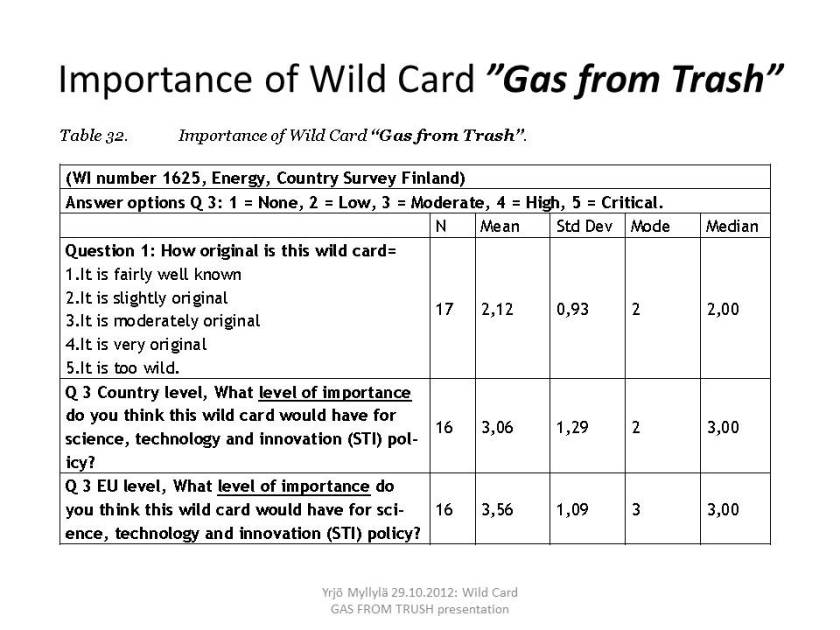
Table 32.

Table 32.

Likelihood of wild card “Gas from Trash” occuring in the short term is “moderate”, longer-term “high” (Table 33).

Table 33.

Table 33.

Strategies for improving the preparedness for this Wild Card, and level preparedness of decision-makers

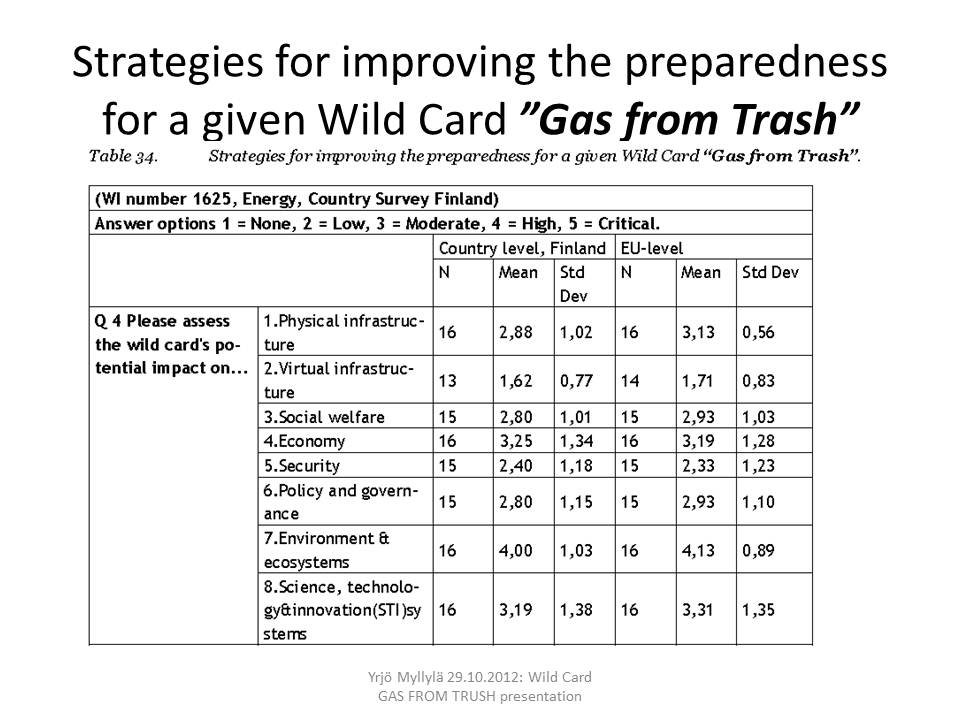
The wild card’s potential impact is greater at country level Finland and in the EU-level for “Environment & ecosystems, Economy and  Science, technology&innovation(STI)systems” (see Table 34 and Figure 13).

Table 34.
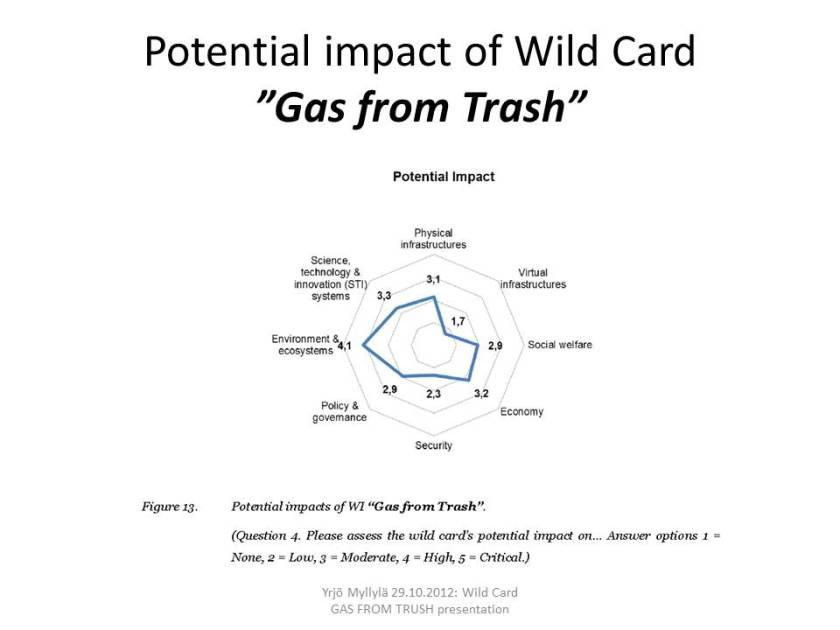
Table 34.

Fig 13.

Fig 13.

The most relevant RTD strategies for this wild card are “Developing cross-national research programmes and priorities,” “Strengthening research institutions’ knowledge production,” “World-class research infrastructures,” “Promoting international cooperation in STI,” and “Sharing knowledge.” (Figure 14).
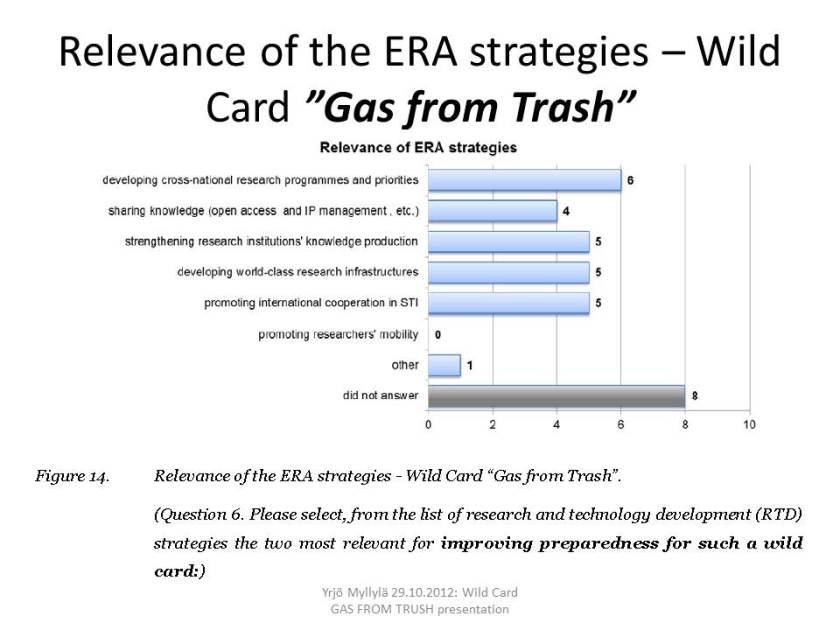
Fig 14.

Fig 14.

From 16 answerers one (6 %) provided advice on policy issues associated to this wild card. Recommendations were Policy shift, Human resource development, and Greater (international) cooperation. There were no comments to explain the contents of the abovementioned recommendations in more detail.

Level of preparedness of decisionmakers to deal with this wild card in country level Finland and EU-level is “low” (Table 35).

Table 35.

Table 35.

In the comments (box below), we can see that many existing signals indicate that such wild card could happen: European Renewable Strategy, high oil price, amount of trash, recent developments in nanotechnology and bioengineering, and the increasing role of waste energy source.
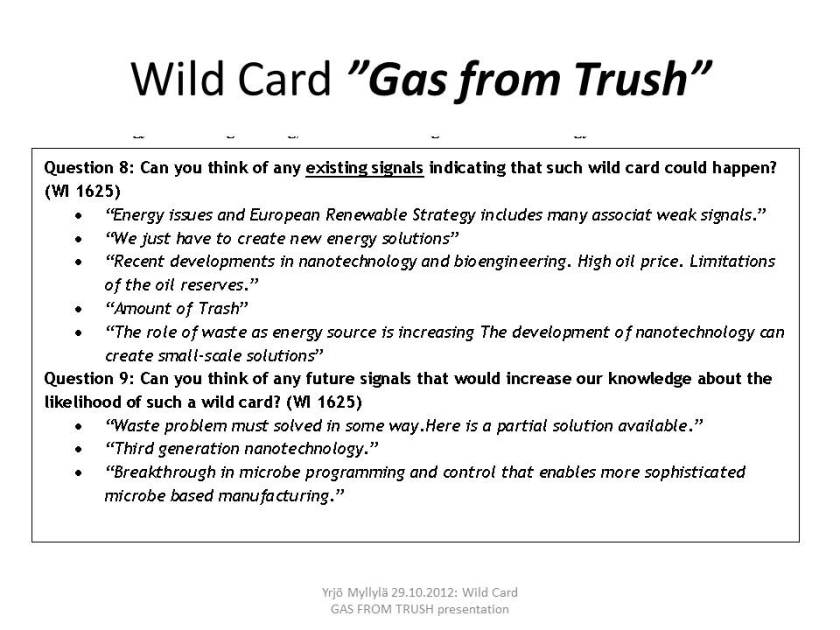
Comments

Comments

Interpretation and conclusions

The production of this wild card is very ‘possible’, and more attention should be paid to it. The preparedness of decision-makers is low. The likelihood of its occurrence is high in the long term. Cross-national research programmes and priorities should be developed by strengthening research institutions’ knowledge production, developing world-class research infrastructures and promoting international cooperation in STI. In Finland a context in which natural gas and gas from trash are combined and distributed in some pipelines already exist in the region of Kouvola. It indicates that in Finland natural gas and gas from Trash (and other biomaterial, like from forest) should be analysed at the same time.

Source:

Myllylä, Yrjö & Maurizio Sajeva & Jari Kaivo-oja & Samuli Aho (2011). iKnow Delphi 2.0  Country Report Finland. 104 p. October 2011. iKnow Project, Finland Futures Research Centre FFRC. < www.iknowfutures.eu>  < http://www.utuonline.fi/sisalto/ajankohtaista/jatteista-tuotettavasta-kaasusta-tarkea-energialahde.html> <http://ffrc.utu.fi/ajankohtaista/iknow.html>

***

For more information, blog articles:

”The Development of Murmansk Region in the light of three scenarios”

1. ALUEKEHITYS, 2. TULEVAISUUDEN ENNAKOINTI, 3. STRATEGIAPROSESSIT, 4. Osaamis- ja koulutustarpeiden ennakointi, 5. Koillisväylä, Arktinen meriteknologia, 6. Kaivostoiminta, 7. Logistiikka ja yhteydet, 8. Energia ja ympäristö, IN ENGLISH, METODI, O. YHDYSKUNTASUUNNITTELU JA MAANKÄYTTÖ

Yrjö Myllylä

.
1. Introduction and objectives

.
This article presents the development of the socio-spatial structures and the
geoeconomic position of the Murmansk Oblast (Figure 1) through the year
2025. The starting point for the analysis is that the appropriate planning of
industry, logistic infrastructure and population is inadequate without a wellgrounded
assessment of the region’s present and future economic conditions and
contingencies. Key concepts of study are Strong Prospective Trends (Toivonen
2004; Kuusi 2008; Naisbitt 1984) and Cluster (Porter 1990; 2006; Malmberg &
Maskell 2002). The study is based on the Delphi method, which is commonly
used within the discipline of futures studies (on the method, see Myllylä 2008a;
Kuusi 1999; Kuusi 2002; Turoff 1975, 2002, 2009; Sackman 1975; for more on
futures studies, see Bell 1997a; 1997b). The main question to be answered involves
what future socio-economic scenarios the Delphi method provides for the
Murmansk Oblast. Figure 1 shows the target region for this study, the population
concentrations and the administrative districts and major towns today.

.

This study is based on material from interviews with a panel of specialists in the
Murmansk Oblast and an analysis of on-going socio-economic development in
the region, together with material from interviews with two additional panels,
one consisting of specialists from Moscow and St. Petersburg and the other an
“international” panel mainly consisting of experts from Finland (See Table 1).

.
2. The background and need for the study

.
The starting point of the article is the idea that the dissolution of the Soviet Union
resulted in a shift of the geopolitical and geoeconomic focus in Russia to the north.
As the main oil-producing regions of the Soviet Union, such as Kazakhstan and
Turkmenistan, became independent, the relative importance of north-western
Russia and Siberia increased in Russia’s oil and gas production (Tykkyläinen
2003). The high prices of crude oil and natural gas products in the global market
have led to the emergence of wealthy, rapidly developing pockets in remote
regional economies. Oil and natural gas are Russia’s main exports, brought to
Europe primarily by oil and gas pipelines, an infrastructure built several decades
ago. Now, however, the situation is changing.

.
Economic interest in northern regions has increased as the growing world
economy demands more energy and the resources in existing oil and gas fields
are being depleted. The Arctic region is rich in oil and natural gas. The rising
prices of raw materials are making the exploitation of Arctic natural resources
more profitable than before. These regions are located northeast of Finland.
What role will Murmansk’s northern location have in the new, rapidly developing
transport system? What impact will the fact that the Murmansk Region is located
relatively close to key market areas – the European Union and the increasingly
important eastern coast of the United States – have on the development options
for the region (Figure 2)? How will other geographical factors, such as an ocean
port that is ice-free the year round, affect the development options available to
the Murmansk Region? What effect will the change have on the development of
industry and logistics in the Murmansk Region and how will it affect social trends
there?”

Source pages 61-62:

Myllylä, Yrjö (2010). The Development of Murmansk Region in the light of three scenarios. In the book: Nysten-Haarala, Soili & Katri Pynnöniemi (eds.) (2010). Russia and Europe: from mental images to business practices. Papers from the VII International Conference of Finnish Russian and East European Studies and other writings Kotka, Finland 2010 Publications of Kymenlaakso University of Applied Sciences. Series B.
Research and Reports. No: 65. 61-79.

See all article:

<http://aluekehitys.internetix.fi/fi/sisalto/05_julkaisut/kyamk2010>

<https://publications.theseus.fi/bitstream/handle/10024/32599/Kyamk_B65_nettiversio.pdf?sequence=1>

Contributor

Yrjö Myllylä, Doctor of Social Sciences, has been working as a researcher in the
Department of Geography at the University of Joensuu (Current University of
Eastern Finland). In his doctoral dissertation (2007), Dr Myllylä evaluated the
industrial, social and logistic developments in the Murmansk region by using the
Delphi Method. His scientific interests also include innovative entrepreneurship,
clusters and internationalization of small and medium size enterprises. Dr Myllylä
currently works as a research consultant at Oy Aluekehitys RD.