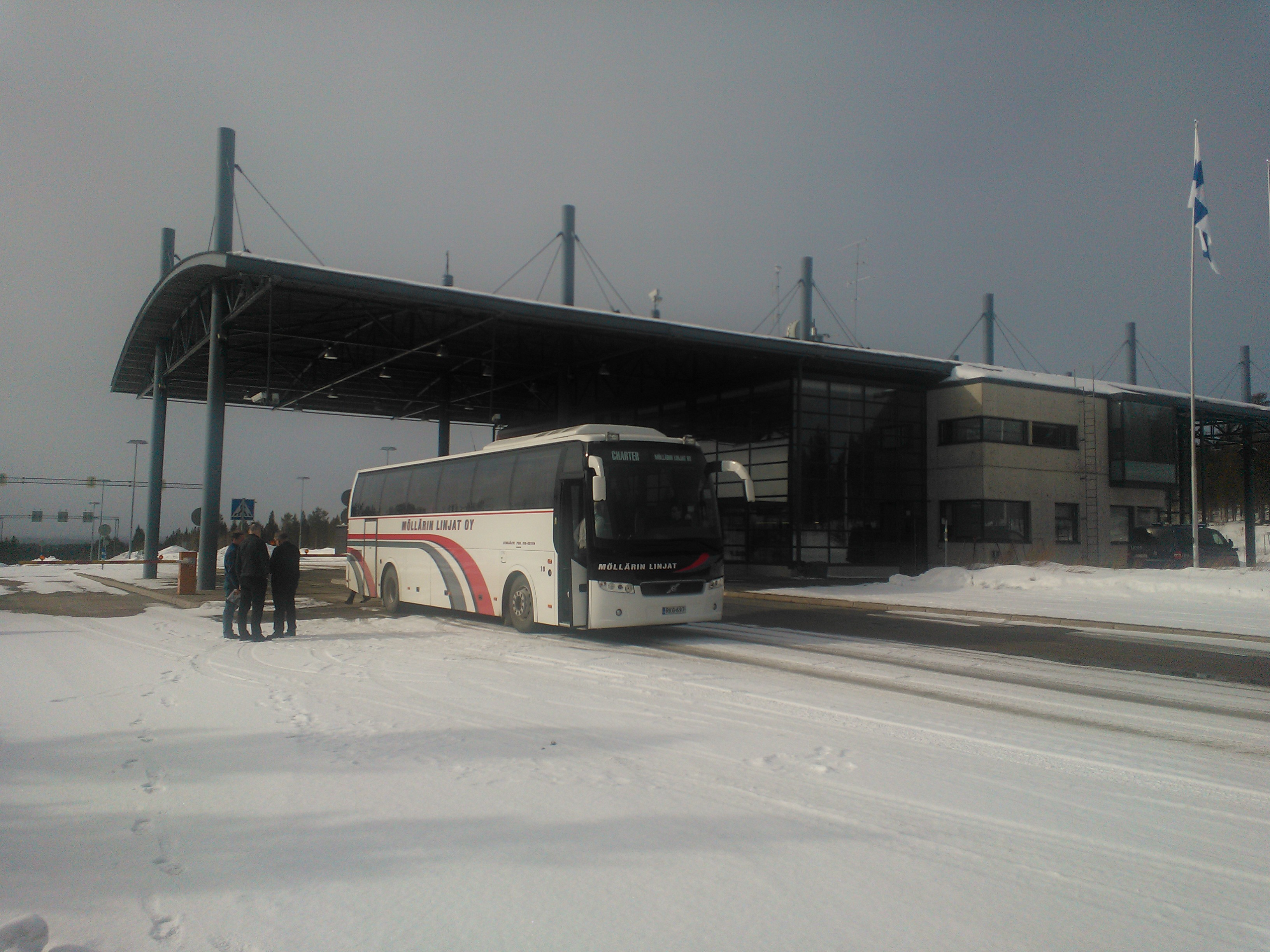
Salla border station is modern and efficient. The border was opened to international traffic in 2002. Barents Logistic 2 project organized trip to Murmansk region in April 2013. Photo April 2013, Yrjö Myllylä.
Johan Wallin
Master of Science in Engineering Technology
From Abstract:
”The study provides a mapping and description of the flow of goods by road transportation across the two northernmost border crossings of Finland towards Russia, and a unique overall view is presented of the cross-boundary logistics in this region.
Rather than having a focus on grand-scale need for investments in infrastructure, this study aims to highlight the present situation in the Barents region and what is feasible to achieve with existing infrastructure and resources. The study has been executed since the potential for trade and cooperation between the countries in the region is perceived to be far greater than what is currently experienced. It should be noted that the total population of the Barents region is about 5.5 million. Of these, about 788 000 people live in the Murmansk region. This can for instance be compared with the population of the counties of Norrbotten and Västerbotten, amounting to around 248 000 and 260 000 respectively.”
…
”Enhanced logistics services would facilitate supply chain solutions across the national borders in the Barents region, and the Murmansk area appears to be relatively unexploited by west European companies. As a result of globalization, the general importance of effective Supply Chain Management is increasing for businesses. Accordingly, global sourcing has become part of the purchasing strategy for many companies. Still, there are challenges connected to global sourcing but these can be mitigated if the geographical distance is reduced between the supplier and the customer. For instance, this would be the case if a Nordic company locates some of its production to the Murmansk region instead of placing it in Asia.”
”This study has been made during the first half of year 2013 as a part of the Barents Logistics 2 project.”
Further information
All Abstract and publication i available in follow one link http://pure.ltu.se/portal/en/studentthesis/crossborder-logistics-between-eu-and-russia(a7d7f4f6-8d4e-4539-bc88-09b576ce2852).html
About Barents Logistic 2 –project’s trip to Murmansk:
- “Arctic Logistics” III International Conference in Murmansk 9.4.2013
- Arctic Logistics -konferenssi Murmanskissa, kaivosvierailu Kirovskissa ja muita huippuhetkiä 7.-11.4.2013 Murmanskin alueella (in Finnish)
- III Международная конференция «Логистика в Арктике» (Russian)
- Barents Logistics II seminar and study visit in Murmansk, Russia 23 – 25 of November 2011
Relation to Barents Logistic 2 topic
- Uutta voimaa kuljetusalalle Koillis-Suomessa, 2011 (in Finnish)
- Koillis-Suomen elinkeinostrategia 2011-2015 (in Finnish)
In Johan Wallin’s thesis is Murmansk map by author Yrjö Myllylä. You will find this original publication from follow one link
- Myllylä, Yrjö (2006). The future of the Murmansk Oblast assessed by three Delphi panels. Fennia 184:1. 53-73. <http://ojs.tsv.fi/index.php/fennia/article/view/3732/3523>
- See also blog article ”The future of Murmansk Oblast assessed by three Delphi panels”
Historien på finsk:
 Yrjö Myllylä